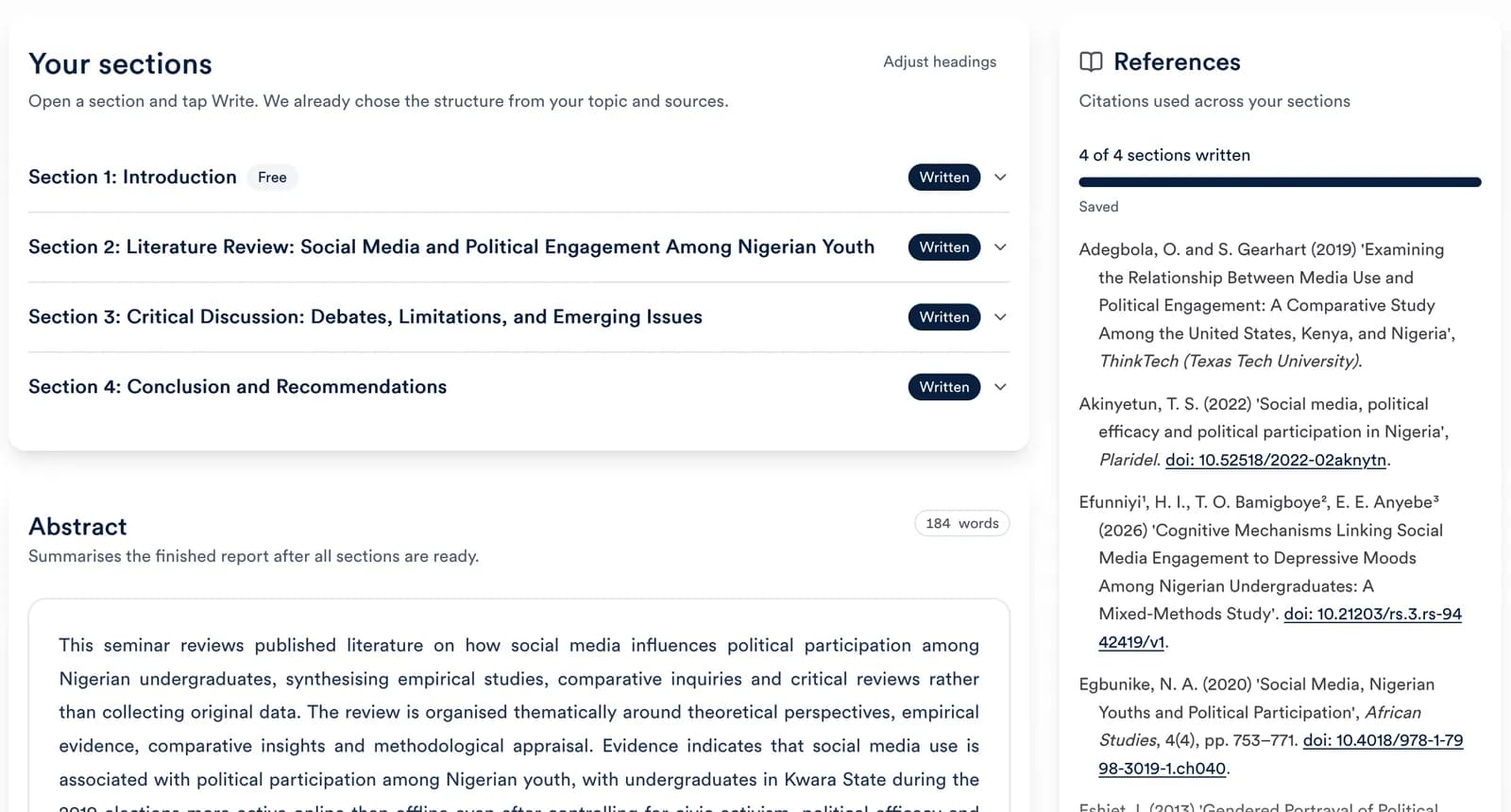
Sources you can open
Find published sources first. Read abstracts, keep what fits, and leave the rest.
The problem
The approach
Research, structure, citations, and export — then you review and finish it in Word.
Find published sources first. Read abstracts, keep what fits, and leave the rest.
Plan around your topic and lecturer instructions — not a five-chapter final year project.
Switch citation style at any time. In-text citations and the reference list update together.
Write, revise, and edit one section at a time. Previous wording stays available if you need it back.
DOIs and source links stay attached so you can open the paper, not just the formatted line.
Download an editable .docx for printing, further edits, or submission.
Four steps from topic to export.
Topic, school, your name and registration number, and any lecturer instructions.
We find published papers and official Nigerian pages that fit the topic.
Write one section at a time, with citations from the sources we chose.
Review the report, then download Word or PowerPoint.
Short answers. You still review the draft before you submit.
A seminar report for undergraduate courses in Nigerian universities and polytechnics: sources, structure, citations, and a Word file you can finish. It is not a five-chapter final year project, and it will not invent survey, lab, or simulation results.
Yes. Details, research, the outline, and the first section stay free. Remaining sections, the abstract, revisions, and the Word download unlock with one ₦4,000 payment on that seminar.
APA, IEEE, MLA, Harvard, and Chicago. You can switch after drafting. Always check the formatted references against the original papers and your department guide.
Yes. Drafts use available abstracts, not full papers. Open the ones you cite, and do not submit text you cannot explain.
No. Research runs against real publication records first, citations stay as source markers, and export is a structured Word file. You remain responsible for the final submission.